

How Long Does SEO Take? Realistic Timeline for Local Business Results
How long does SEO take to work? This is the first question every business owner asks me. After 30 years in digital marketing and running an SEO agency in Orlando, I can give you the honest answer: 3 to 12 months, depending on your competition, your starting point, and how aggressively you invest. That range is wide because every business starts in a different place.
Let me break down exactly what happens month by month so you know what to expect — and so you don’t get burned by an agency that promises miracles.
From the auditor: Dennis Ocasio has delivered digital marketing for 200+ small businesses across Central Florida over 30+ years. Every recommendation here comes from tested, real-world client work — not theory.
The Honest Answer Nobody Wants to Hear
If someone tells you they can get you to page 1 of Google in 30 days, run. SEO doesn’t work that fast for competitive keywords. It’s not a switch you flip. It’s a foundation you build brick by brick.
That said, local SEO moves faster than national SEO. If you’re targeting “plumber in Oviedo” instead of “best plumber in America,” you’ll see results sooner because there’s less competition. The Orlando market is competitive but not impossible — especially for specific service and neighborhood keywords.
Google needs time to discover your content, evaluate it, test it against competitors, and decide where to rank it. You can’t shortcut that process. What you can do is give Google every reason to trust your site faster by doing the right things consistently.
Month-by-Month SEO Timeline

Month 1: Foundation and Audit
This is setup month. Nothing visible happens to your rankings yet, but everything that happens now determines how fast you’ll see results later.
Here’s what we do in month 1:
- Technical audit: Crawl your site to find broken links, slow pages, missing meta tags, duplicate content, indexing issues, and mobile problems
- Google Business Profile optimization: Complete every field, add photos, set categories, and verify your listing (see our GBP optimization guide)
- Keyword research: Identify the 20-50 keywords your ideal customers are searching for, prioritized by volume, competition, and intent
- Competitor analysis: See who’s ranking for your target keywords, what they’re doing right, and where they’re vulnerable
- Content strategy: Map out which pages need to be created, which need to be optimized, and what blog content to publish over the next 6-12 months
- On-page optimization: Fix title tags, meta descriptions, heading structure, internal linking, and image alt text on your existing pages
You won’t see ranking changes in month 1. That’s normal. Think of it as pouring the foundation before building the house.
Month 2-3: Building Content and Citations
Now the real work begins. This is where most SEO investments start showing early signals.
- Content creation: Publishing 2-4 blog posts per month targeting your keyword strategy. Each post targets a specific keyword cluster and links back to your service pages
- Citation building: Getting your business listed on 30-50 directories (Yelp, BBB, Clutch, DesignRush, etc.) with consistent name, address, and phone number
- Internal linking: Connecting new blog posts to service pages and related content so Google understands your site structure
- Early backlink outreach: Guest posts, local business partnerships, and directory submissions
By the end of month 3, Google has started crawling your new content. You might see movement for long-tail keywords (those longer, more specific search phrases). Your main keywords probably haven’t moved much yet. That’s still normal.
Month 4-6: Traction Starts
This is where things start getting interesting. The content you published in months 2-3 has had time to be indexed, crawled, and evaluated by Google.
- Long-tail keywords: Several of your blog posts start ranking on page 1 for specific, lower-competition searches
- Primary keywords: Your main service keywords move from page 5-10 to page 2-3. Not page 1 yet, but movement is happening
- Organic traffic: Increases 20-50% compared to where you started
- Google Maps: Your GBP listing starts appearing for more searches, especially in the areas closest to your physical location
- Phone starts ringing: You begin getting organic leads — maybe 2-5 per week. Not a flood, but proof that SEO is working
This is the point where many businesses that started SEO and gave up after 2 months are kicking themselves. Months 4-6 are when the investment starts paying off.
Month 7-12: Real Growth
Now the compounding effect kicks in. Every piece of content you’ve published is working together to build your authority.
- Primary keywords hit page 1: Your main service keywords start ranking in the top 10. Some hit the top 5 or top 3
- Local pack dominance: Your business appears in the Google Maps 3-pack for multiple searches in your service area
- Organic traffic doubles or triples: Compared to where you started, you’re getting 2-3x the visitors from Google
- Consistent lead flow: 10-30+ organic leads per month depending on your industry and market
- Content authority: Google recognizes your site as an authority in your niche. New content ranks faster because your whole site has authority
Year 2 and Beyond: Compounding Returns
This is where SEO becomes the best marketing investment you’ve ever made. Your content library keeps growing. Domain authority keeps building. Rankings get stronger and harder for competitors to displace.
Your cost per lead from organic search drops dramatically compared to paid ads. A blog post you published 18 months ago is still bringing leads today — for zero additional cost. That’s the compounding power of SEO that no other marketing channel can match.
Factors That Affect Your SEO Timeline
Not all businesses will follow the same timeline. Here’s what speeds things up or slows them down:
Domain Age and History
Older domains that have been active for years have more inherent authority with Google. A brand new domain starts from zero trust. If you’re on a new domain (like we did with ocasioconsulting.com), expect a slightly longer ramp-up than if you’d been on the same domain for 10 years.
Competition Level
“Lawyer Orlando” has massive competition — dozens of firms spending $10,000+/month on SEO. That takes longer. “Accountant Alafaya” has much less competition. Less competitive keywords rank faster.
Your Current Site Health
A site with existing content, some backlinks, and no penalties starts faster than a brand new site with zero content. If you already have 20 blog posts and decent domain authority, you’re ahead of the game.
Content Investment
Publishing 4 posts per month beats 1 post per month. More content means more keywords targeted, more entry points for organic traffic, and faster topical authority. The businesses that invest aggressively in content see results faster.
Backlink Quality
Sites with quality backlinks from reputable sources rank faster. Earning backlinks from industry publications, local business partners, and directories accelerates your timeline. Buying cheap backlinks from link farms does the opposite — it can get you penalized.
Local SEO vs National SEO Timelines
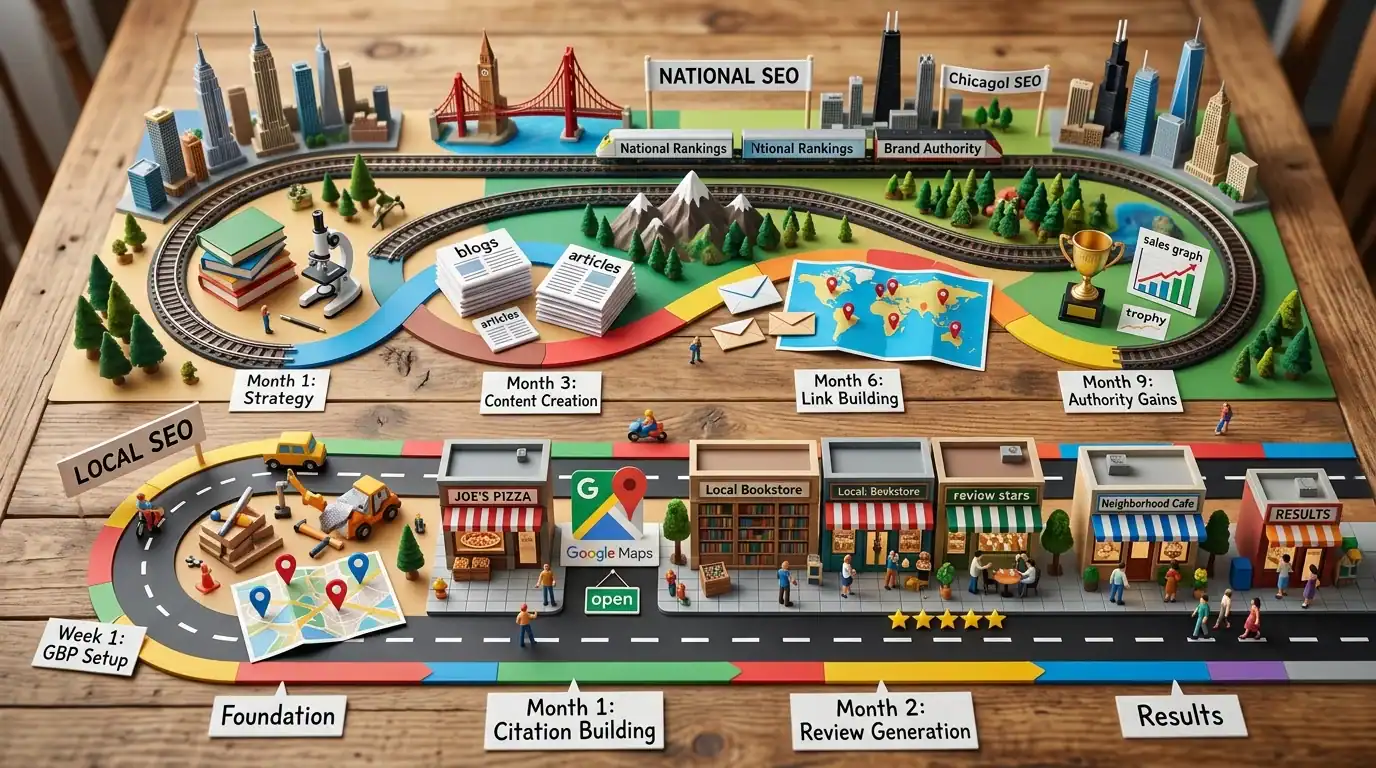
Local SEO (targeting one city or region): 3-6 months for meaningful results. Less competition, more focused keywords. Google Business Profile is a quick win — you can start appearing in Maps results within weeks of optimizing your profile properly.
National SEO (targeting the entire US or country): 6-12+ months. Much more competition. Requires significantly more content, stronger backlinks, and deeper investment.
For Orlando businesses, local SEO is where the fastest ROI lives. You’re competing against 20-50 local businesses, not 20,000 national ones.
Red Flags: When SEO Promises Are Too Good to Be True
I’ve been in this industry for 30 years, and I’ve seen every scam, shortcut, and broken promise. Watch out for these:
- “Guaranteed #1 rankings” — Nobody can guarantee this. Google’s algorithm considers over 200 factors and changes constantly. Any agency that guarantees specific rankings is either lying or using tactics that will get you penalized
- “Page 1 in 30 days” — Only possible for zero-competition keywords that nobody searches for. If someone promises this for competitive terms, they’re setting you up for disappointment
- “Secret techniques” — There are no secrets in SEO. Just good fundamentals done consistently over time. Anyone claiming proprietary secrets is selling smoke
- “$99/month SEO” — Real SEO costs $800-$2,500/month. At $99, you’re getting an automated report and maybe a few directory submissions. You’re not getting strategy, content, or real optimization. See our local SEO pricing guide for realistic numbers
- “We’ll do all the work, you just wait” — Good SEO requires collaboration. You know your business better than any agency. If they don’t ask you questions about your customers, your services, and your competitive advantage, they’re not doing real SEO
How to Know If Your SEO Is Working

Don’t wait 12 months to evaluate. Check these leading indicators monthly:
- Month 1-2: Technical issues fixed. Content strategy in place. GBP optimized. These are process metrics, not outcome metrics
- Month 3-4: New content published and indexed. Long-tail keyword movement visible in Google Search Console. Organic impressions increasing
- Month 4-6: Organic traffic growing 10-20% month over month. Some keywords on page 2-3 of Google. First organic leads coming in
- Month 6-12: Primary keywords on page 1. Organic traffic up 50-100%+ from start. Consistent organic lead flow
If you’re at month 6 with zero movement, zero traffic growth, and zero leads — something is wrong with the strategy, the execution, or both. That’s when you need to have an honest conversation with your SEO provider.
Frequently Asked Questions
Can I speed up SEO?
Yes — invest more in content creation and link building. Publishing 8 posts per month instead of 2 accelerates your keyword coverage. Earning quality backlinks from guest posts and partnerships builds authority faster. But you can’t cheat the timeline. Google needs to crawl, index, and evaluate your content regardless of how much you produce.
Why does my competitor rank higher than me?
They probably started earlier, have more content, more backlinks, more reviews, and a stronger domain. The gap closes as you invest consistently. Check their backlink profile with a tool like Ahrefs or Moz — you’ll see exactly why they rank higher and what you need to match.
What happens if I stop SEO after 6 months?
Your rankings hold for a while — maybe 3-6 months. Then they gradually decline as competitors keep publishing, building links, and earning reviews. SEO is ongoing maintenance, not a one-time project. Think of it like going to the gym: you can stop, but you’ll slowly lose what you built.
Is local SEO faster than regular SEO?
Yes. Less competition means faster results. Google Business Profile optimization can show results within weeks. Local pack rankings can happen within 2-3 months with proper GBP optimization, citations, and reviews.
How much should I invest in SEO per month?
$800-$2,500/month for local SEO is the realistic range. Below $800, you’re probably not getting enough content or optimization to move the needle. Above $2,500, you’re either in a very competitive market or you’re over-investing for your business size. See our complete pricing guide for detailed breakdowns.
Should I do SEO myself or hire an agency?
If you have time to learn and execute — writing 2-4 blog posts per month, optimizing pages, building citations, managing reviews, monitoring rankings — you can do basic SEO yourself. For competitive markets or if you want faster results, hire a professional. The cost of an agency is usually less than the cost of your time doing it yourself (and getting it wrong).
What’s the ROI of SEO after 12 months?
Our clients typically see 500-2,000% ROI on their SEO investment after 12 months. That means for every $1,000 spent on SEO, they’re generating $5,000-$20,000 in revenue from organic leads. The exact number depends on your close rate, average deal size, and how competitive your market is.
The Bottom Line

SEO takes time. That’s not a weakness — it’s the reason it works. The businesses that commit to 12+ months of consistent SEO end up with a lead generation machine that works 24/7, costs nothing per click, and compounds in value every month.
The best time to start SEO was 6 months ago. The second best time is today.
Schedule a free consultation and I’ll give you an honest assessment of your timeline based on your specific market and competition. Or call me directly at (321) 300-4837.
Check our SEO services, local SEO services, and pricing guide for the full picture.
If this raised more questions than it answered, we’ve got answers to common SEO questions in our FAQ — covering everything from pricing and timelines to what results actually look like. You can also read verified client reviews from businesses we’ve helped across Orlando and Central Florida.
Curious what investing in SEO actually looks like? We have transparent pricing for every service we offer. See our SEO pricing and packages to see what every service costs.
I also keep a set of free marketing tools on the Ocasio Consulting website to help you do this kind of analysis yourself.
We’ve run successful SEO campaigns for businesses throughout our Central Florida service area.