

Industry-Specific SEO: How to Rank for Your Niche in Orlando
Generic SEO advice is everywhere. “Optimize your title tags. Build backlinks. Create great content.” Sure, that’s all true. But industry-specific SEO is what separates businesses that actually rank from businesses that just read about ranking. The SEO strategy for a dentist in Winter Park is fundamentally different from the strategy for a roofing contractor in Alafaya or a B2B consultant in Lake Mary.
After 30 years helping businesses across dozens of industries rank in Google, I’ve learned that the details matter most. The keywords, the content format, the conversion path, the competition level, and the local search dynamics all change based on your industry. A one-size-fits-all SEO strategy leaves money on the table for every business that follows it.
Let me show you how to approach SEO for your specific business type — with strategies tailored to the industries I work with most in the Orlando market.
From the auditor: Dennis Ocasio has delivered digital marketing for 200+ small businesses across Central Florida over 30+ years. Every recommendation here comes from tested, real-world client work — not theory.
Why Generic SEO Advice Falls Short
Most SEO articles are written for everyone, which means they’re truly useful for no one specifically. They tell you to “target long-tail keywords” but don’t tell you which long-tail keywords matter for a plumber versus an accountant versus a restaurant. They say “build quality content” but don’t explain that a home services company needs photo-heavy before-and-after content while a B2B company needs data-driven whitepapers and case studies.
Your industry determines everything about your SEO approach:
- Keyword intent patterns: “Emergency plumber near me” has completely different intent than “best project management software for marketing teams.” The first person needs help RIGHT NOW. The second person is researching a purchase they’ll make in weeks or months. Your content and conversion strategy must match the intent
- Content format requirements: Service businesses need location-specific service pages and before-and-after galleries. E-commerce needs optimized product descriptions and buying guides. B2B needs long-form thought leadership and case studies. Restaurants need menus, photos, and reservation integration
- Conversion path design: Some industries convert through phone calls (plumbers, emergency services). Others through form submissions (consulting, B2B). Others through online bookings (salons, restaurants). Others through purchases (e-commerce). Your site structure and CTAs need to match how YOUR customers actually buy
- Competition level: Legal SEO in a major city is brutally competitive — dozens of firms spending $10,000+/month. A specialized B2B service might have almost zero online competition. Your budget and timeline expectations must match your competitive reality
- Local vs national focus: A restaurant is 100% local. A SaaS company is 100% national. A contractor serves a specific region. An e-commerce store might serve nationally but focus locally. Your SEO scope must match your actual service geography
SEO for Home Service Businesses (Plumbing, HVAC, Electrical, Roofing, Landscaping)

Home service businesses are the bread and butter of local SEO. These businesses live or die by local search visibility — when someone has a leaking pipe at 10 PM, they search “emergency plumber near me” and call the first business they find.
Top SEO Priorities for Home Services
Google Business Profile is your #1 asset. A fully optimized GBP is worth more than 100 blog posts for a home service business. Your GBP listing appears in the local map pack — the top 3 business listings with the map that shows before organic results. More than 40% of local search clicks go to the map pack. See our complete GBP optimization guide.
Service area pages for every city you serve. Create dedicated pages for each city or neighborhood in your service area. “Plumbing Services in Alafaya” and “Plumbing Services in Winter Park” are different keywords targeting different customers. Each page needs unique, locally relevant content — not the same page with the city name swapped. We built 10 geo pages for Ocasio Consulting following this exact approach.
Reviews are your ranking fuel. Home service businesses need reviews more than almost any other industry because trust is critical — you’re letting someone into your home. Aim to have more reviews than your top 3 competitors with a higher average rating. Implement a systematic review request process: ask every customer after a completed job, make it easy with a direct link, and respond to every review within 24 hours.
Before-and-after content is gold. Photo galleries and case studies of completed projects serve double duty: they rank in Google Image Search (driving additional traffic) and they convert visitors by showing your work quality. A gallery of 20 kitchen remodel before-and-afters is more persuasive than any paragraph of marketing copy.
Emergency keywords deserve dedicated targeting. If you offer emergency services, target those keywords aggressively with dedicated landing pages. “Emergency plumber Orlando” has incredibly high conversion intent — that person is calling someone in the next 5 minutes. Make sure it’s you.
Content Strategy for Home Services
Blog about the questions your customers ask: “How much does a bathroom remodel cost in Orlando?” “Signs your AC needs replacement.” “How to choose the right roofing contractor.” “What to expect during a kitchen renovation.” Every customer question is a blog post that hundreds of potential customers are searching for right now.
SEO for Professional Services (Lawyers, Accountants, Consultants, Financial Advisors)
Professional services SEO is about building authority and trust. Your customers are making high-stakes decisions — hiring a lawyer, choosing an accountant, engaging a consultant for a $50,000 project. They need to trust you deeply before they’ll make that call.
Top SEO Priorities for Professional Services
E-E-A-T signals are mandatory. Google holds professional service websites to higher quality standards than most industries, especially for YMYL (Your Money, Your Life) topics. Every piece of content needs: author bios with credentials, clear expertise demonstration, client testimonials and case study results, industry certifications displayed prominently, and consistent publication that shows ongoing expertise.
Practice area pages are your core keyword targets. A law firm needs separate, comprehensive pages for each practice area: personal injury, family law, criminal defense, estate planning. An accounting firm needs pages for tax preparation, bookkeeping, audit services, business consulting. Each practice area is a different keyword target and a different buyer persona.
Educational content builds trust at scale. Professionals win by teaching. “What to do after a car accident in Florida” from a personal injury lawyer. “Small business tax deductions you’re probably missing” from an accountant. “How to evaluate a digital marketing agency” from a consultant (like our PPC vs SEO guide). Educational content demonstrates expertise and positions you as the authority — so when someone needs your service, you’re already their first choice.
Local + practice area keyword targeting. The core keyword pattern for professional services is “[practice area] + [city].” “Divorce attorney Orlando.” “Business accountant Winter Park.” “Digital marketing consultant Alafaya.” Target these on your practice area pages with comprehensive, authoritative content.
SEO for Restaurants and Local Retail
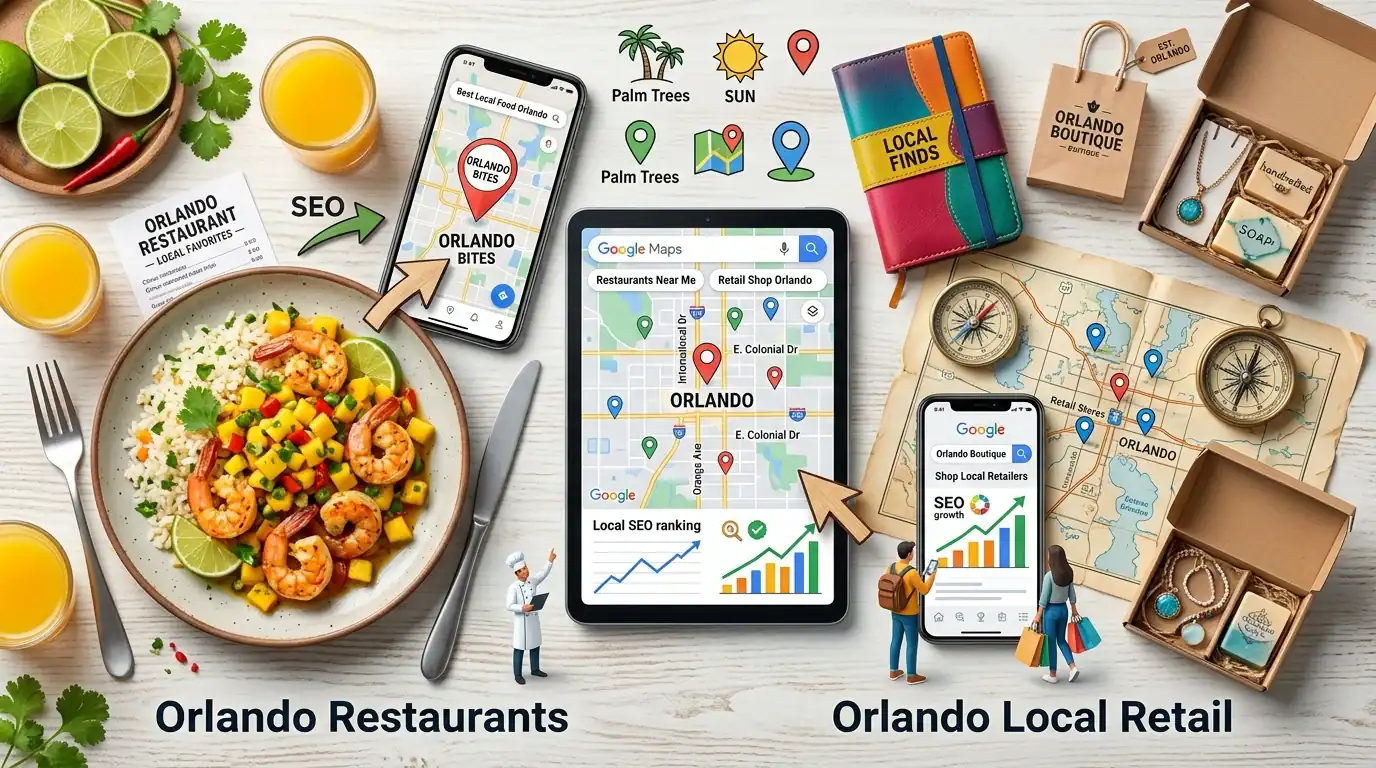
Restaurant and retail SEO is hyperlocal and time-sensitive. Your customer is within 5-10 miles of your location and making decisions right now — often on their phone while walking down the street or sitting in their car.
Top SEO Priorities for Restaurants/Retail
Google Business Profile is EVERYTHING. More critical than for any other industry. Complete your menu (or product catalog), add 50+ high-quality photos, keep hours perfectly accurate, enable reservations or online ordering, and post weekly updates. Your GBP listing is your primary storefront for online discovery.
Review volume wins. Restaurants need 100+ reviews to compete in most markets. The sheer volume signals popularity and trustworthiness. Actively ask every diner or customer — table cards, receipt prompts, follow-up texts. Make it frictionless.
Photo quality converts. Professional food photography or high-quality phone photos of your dishes, interior, and team. Bad food photos are worse than no photos — they actively turn people away. Invest in good visuals. For retail, product photos should be clear, well-lit, and show items in context.
Online ordering/reservation integration. Make it easy to take action directly from search results. Google supports reservation links, online ordering links, and menu links directly in your GBP listing. Every friction point removed increases conversions.
SEO for E-Commerce Businesses
E-commerce SEO is about product visibility at scale. You’re competing with Amazon, Walmart, and thousands of niche online stores for product-related searches.
Top SEO Priorities for E-Commerce
Product page optimization at scale. Every product needs: a unique description (not the manufacturer’s copy that 50 other stores use), optimized title tags with product name and key attributes, high-quality images with descriptive alt text, and Product schema markup for rich snippets in search results.
Category pages matter more than product pages. For broader searches (“women’s running shoes”), category pages often rank better than individual products. Add 200-500 words of unique, helpful content to each category page explaining what the category offers and why your selection stands out.
Technical SEO is critical at scale. Large product catalogs create unique challenges: faceted navigation generating duplicate URLs, out-of-stock products creating 404s, product variations creating thin content, and crawl budget limitations. Site speed is especially critical because every second of load time costs 7% of conversions — and e-commerce depends entirely on online conversions.
Content marketing drives organic product discovery. Buying guides (“Best running shoes for flat feet 2026”), comparison posts (“Nike vs Adidas: Which is better for trail running?”), and how-to content (“How to choose the right running shoe for your foot type”) attract buyers in the research phase and drive them to your product pages.
SEO for B2B Companies
B2B SEO focuses on thought leadership and decision-maker targeting. Your customer isn’t impulse-buying — they’re researching for weeks or months, comparing 3-5 vendors, and presenting options to their team before making a decision.
Top SEO Priorities for B2B
Long-form, authoritative content. B2B buyers consume more content before purchasing than any other segment. Whitepapers, comprehensive guides, industry reports, and detailed case studies (see our case study creation guide) establish you as the expert voice in your space.
LinkedIn integration is essential. B2B content should be promoted heavily on LinkedIn where decision-makers spend their professional time. Your SEO and LinkedIn strategies should reinforce each other — blog posts drive organic traffic, LinkedIn posts drive engagement and brand awareness.
Comparison and “versus” content captures buyers in evaluation mode. “Your Solution vs Competitor.” “Top 5 [category] Tools Compared.” “How to Choose a [your service type].” B2B buyers actively search for comparison content. Ranking for these queries puts you in front of qualified prospects who are actively choosing a vendor.
Case studies with data are your most powerful content. “We helped [company type] increase [metric] by [percentage] in [timeframe].” Real numbers with real context are the most persuasive B2B content format. Every case study is also an SEO asset targeting industry-specific keywords.
SEO for Healthcare and Medical Practices
Healthcare SEO operates under Google’s strictest quality standards. Medical content is classified as YMYL (Your Money, Your Life), meaning Google requires the highest levels of E-E-A-T. Mistakes in healthcare content don’t just hurt rankings — they can harm people.
Top SEO Priorities for Healthcare
Author credentials on every piece of content. Every article should be attributed to a qualified medical professional. Include degrees, certifications, practice specialization, and institutional affiliations. Google Quality Raters specifically check author credentials for medical content.
Medical accuracy is non-negotiable. Content must be factually accurate, evidence-based, and up-to-date. Google actively penalizes medical content that contradicts established medical consensus. Cite reputable sources. Have qualified professionals review content before publication.
Service-specific pages for each condition, procedure, or specialty. “Dental implants Orlando.” “Knee replacement surgery Winter Park.” “Pediatric dentist near Alafaya.” Each medical service or procedure deserves its own comprehensive page targeting the specific keywords patients search for.
Patient reviews drive local visibility. While maintaining HIPAA compliance (patients can voluntarily leave reviews; you cannot solicit reviews that would reveal protected health information), reviews are critical for healthcare local SEO. Focus on Google reviews and respond professionally to each one.
How to Find Your Industry’s SEO Opportunities
Regardless of your specific industry, this process works for identifying your unique SEO opportunities:
- Competitor audit: Search your main keywords. Who ranks on page 1? Study their sites. What topics do they cover? What content formats do they use? How deep is their content? Where are they weak?
- Gap analysis: What topics are your competitors NOT covering? Those gaps are your biggest opportunities. Maybe nobody in your market has a comprehensive pricing guide. Maybe nobody’s created industry-specific case studies. Maybe nobody’s targeting specific neighborhoods in your service area
- Keyword mapping: List every service you offer. For each service, find the top 5-10 keywords people search. Group them into topic clusters. Create or optimize a page for each cluster
- Content differentiation: Don’t just create the same content your competitors have. Bring your unique experience, your specific data, your local knowledge, your real client results. That’s what Google rewards with E-E-A-T signals and what separates your content from generic articles
- Technical foundation: Make sure your site is fast, mobile-friendly, properly structured with schema markup, and free of crawl errors before investing heavily in content. Technical problems undermine everything else. See our technical SEO checklist
Frequently Asked Questions
Does my industry affect how long SEO takes?
Yes, significantly. Highly competitive industries (legal, medical, real estate in major cities) take 6-12+ months for competitive keywords because you’re fighting established players with large budgets. Less competitive niches (specialized B2B services, unique local services) can see results in 3-6 months. See our SEO timeline guide for month-by-month expectations.
Should I hire an SEO agency that specializes in my industry?
Industry experience helps but isn’t the most important factor. What matters more is: strong SEO fundamentals (technical skills, content quality, link building ability), local market knowledge (understanding the Orlando competitive landscape), and willingness to learn your specific business deeply. At Ocasio Consulting, we work across industries because the SEO fundamentals are universal — we adapt the strategy to your specific market dynamics.
How much should my industry spend on SEO?
More competitive industries need bigger investments. A local service business in a moderate market: $800-$1,500/month. A professional service firm in a competitive market: $1,500-$3,000/month. A law firm in a major metro competing for high-value keywords: $3,000-$5,000+/month. See our local SEO pricing guide for detailed breakdowns.
What’s the most important ranking factor across all industries?
Content quality and relevance. Google’s algorithm has become sophisticated enough to evaluate whether content genuinely helps the searcher. Across every industry, the businesses that rank highest are the ones producing the most helpful, comprehensive, accurate content for their target audience. Technical SEO, backlinks, and other factors matter — but content is the foundation.
Can I compete with big companies in my industry?
On broad, national keywords? Usually not immediately. On local, specific, long-tail keywords? Absolutely. “Best plumber in America” is unwinnable. “Emergency plumber Alafaya FL” is very winnable. Local focus, specific expertise, and genuine helpfulness beat corporate budgets for local and niche searches.
Next Steps

Want an SEO strategy built specifically for your industry and market? Schedule a free consultation or call (321) 300-4837. We’ll analyze your competitive landscape, identify the keywords that matter most for your specific industry, and build a strategy that fits your business — not a generic template.
Check our SEO services and local SEO services for our complete approach.
Read more: Keyword Research Guide | How Long Does SEO Take | Local SEO Pricing
If this raised more questions than it answered, we’ve got answers to common SEO questions in our FAQ — covering everything from pricing and timelines to what results actually look like. You can also read verified client reviews from businesses we’ve helped across Orlando and Central Florida.
Before you build your SEO strategy, it helps to understand who your Alafaya customers really are — our community guide covers the demographics, income levels, and neighborhood breakdown behind East Orlando’s biggest growth corridor.

We have packages for businesses of all sizes on our pricing page. See our SEO service pricing to see what every service costs.
My free keyword intent classifier helps you separate informational searches from commercial ones before you optimize a page.