

Case Study Creation: How to Showcase Your Results and Build Credibility That Closes Deals
Case studies are the most powerful sales content you can create. They’re not your claims. They’re not marketing fluff. They’re documented proof that you deliver results — real outcomes for real clients with real numbers. When a potential customer reads how you helped a similar business increase their leads by 200% or cut their marketing costs in half, they don’t think “nice story.” They think “that could be me.”
After 30 years of marketing and helping businesses in Orlando grow, I’ve written and used case studies to close more deals than any other single piece of content. A well-crafted case study on your website, in your proposals, and in your email sequences works 24/7 as your most convincing salesperson. It answers the two biggest questions every prospect has: “Does this actually work?” and “Has it worked for someone like me?”
Let me show you how to create case studies that actually close business.
From the auditor: Dennis Ocasio has delivered digital marketing for 200+ small businesses across Central Florida over 30+ years. Every recommendation here comes from tested, real-world client work — not theory.
Why Case Studies Convert Better Than Anything Else
Here’s why case studies outperform every other content type for conversion:
Social proof at its strongest. People trust stories from real customers more than anything you could say about yourself. A testimonial says “they’re great.” A case study says “they’re great, and here’s exactly what they did, how long it took, and the specific results I got.” That specificity is what converts.
Specificity builds credibility. “We get great results” is vague and forgettable. “We increased their organic traffic by 250% in 6 months, generating 60 new leads per month and $540,000 in annual revenue” is specific, memorable, and believable. The numbers do the selling.
Relatability drives action. When a plumber reads a case study about another plumber who tripled their leads through SEO, they immediately see themselves in that story. The psychological leap from “that worked for them” to “that could work for me” is short. Without a relatable case study, prospects have to imagine the results. With one, the results are proven.
Objection handling built in. A good case study naturally answers the biggest objections: “Does this really work?” (Yes, here’s proof.) “How long does it take?” (Here’s the timeline.) “What will it cost vs what will I get back?” (Here’s the ROI.) “Will it work for MY industry?” (Here’s a client in your industry.)
SEO and content value. Case studies with industry-specific keywords rank in Google for commercial-intent searches. “Local SEO case study for plumber in Orlando” is a search that potential clients and SEO shoppers actually make. A well-optimized case study brings in organic traffic from people who are actively looking for proof that your service works.
Multi-channel versatility. One case study becomes: a website page, a section in proposals, an email sequence touchpoint, a social media post series, a sales conversation talking point, a Google Ads landing page element, and a lead magnet download. That’s seven uses from one piece of content.
The Perfect Case Study Structure

Every effective case study follows the same narrative arc: challenge → solution → results. Here’s the exact structure I use:
1. The Headline: Lead With the Result
Your headline should make someone want to read the whole thing. Always lead with the outcome, not the client name. “How a Local Contractor Tripled Their Online Leads in 6 Months” gets clicks. “Case Study: ABC Contractors” doesn’t. The result is the hook. Make it specific and impressive.
Good headline formulas:
- “How [Client Type] Achieved [Specific Result] in [Timeframe]”
- “From [Starting Point] to [End Result]: A [Industry] Success Story”
- “[Percentage]% Increase in [Metric]: How We Helped [Client Type]”
2. The Client Snapshot (2-3 sentences)
Briefly describe who the client is so readers can assess relevance. Include: industry, company size, location, and what they do. “ABC Contractors is a residential remodeling company in Orlando, FL with a team of 12. They specialize in kitchen and bathroom renovations for homeowners in the Central Florida area.”
This snapshot lets the reader immediately determine “is this client similar to me?” If yes, they keep reading. If not, they move to a more relevant case study. Having multiple case studies across different industries ensures every prospect finds one that resonates.
3. The Challenge: What Was Broken?
Describe the specific problem the client had before working with you. Use their actual words if possible — real language is more convincing than polished marketing speak. Be specific about the pain points:
“ABC Contractors was getting only 3-5 leads per month from their website despite spending $2,000/month on Google Ads. Their site was built in 2018 and hadn’t been updated since. They had no SEO strategy, no blog content, and their Google Business Profile was incomplete. They were losing bids to competitors who had stronger online presence.”
The challenge section should make the reader nod and think “that sounds like me.” When they recognize their own problem in the case study, they’re emotionally invested in finding out how it was solved.
4. The Solution: What You Actually Did
Explain your approach specifically — not generically. Don’t say “we did SEO.” Say exactly what you did:
“We rebuilt their website on WordPress with conversion-optimized service pages for each of their 8 services. We created 12 blog posts targeting their highest-value keywords (kitchen remodel cost Orlando, bathroom renovation Orlando, contractor near me). We fully optimized their Google Business Profile with complete business information, 40+ photos, and weekly posts. We restructured their Google Ads campaigns with dedicated landing pages per service and added negative keywords that were wasting 30% of their budget. We built citations on 50+ directories and implemented a review request system that generated 25 new Google reviews in 3 months.”
This level of detail accomplishes two things: it proves you know what you’re doing (expertise signal for E-E-A-T), and it shows the prospect exactly what working with you looks like. No black box. No mystery. Just a clear, competent approach they can evaluate.
5. The Results: Numbers, Numbers, Numbers
This is the money section — literally. Include specific metrics with timeframes. Vague results (“traffic improved significantly”) are worthless. Specific results are powerful:
- “Organic traffic increased 250% in 6 months (from 400 to 1,400 monthly visitors)”
- “Monthly leads grew from 5 to 25 (400% increase)”
- “Cost per lead from Google Ads dropped from $400 to $80 (80% reduction)”
- “Google Ads conversion rate improved from 2% to 8%”
- “Google Business Profile views increased by 180%”
- “25 new 5-star Google reviews in 3 months”
- “Revenue increased by $180,000 in the first year attributable to digital marketing”
Present results at multiple timeframes when possible. “At 3 months… at 6 months… at 12 months…” This shows the trajectory and helps prospects understand what they can expect at each stage.
6. Client Quote: In Their Own Words
A direct quote from the client reinforces everything the case study claims. The best quotes include specific results and emotional impact:
“Before Ocasio Consulting, we were invisible online. We’d go weeks without a single web lead. Now we’re getting 5-6 qualified calls per week and had to hire two additional crew members to handle the demand. Our marketing spend went down and our revenue went up — that’s exactly what Dennis promised, and he delivered.” — John Smith, Owner, ABC Contractors
A named quote with the person’s title and company adds credibility. An anonymous quote (“A satisfied client”) has almost no persuasive power by comparison.
7. Call to Action: What Should the Reader Do Next?
Every case study should end with a clear CTA that connects the success story to the reader’s potential: “Want results like these for your business? Schedule a free consultation and we’ll show you what’s possible.”
How to Get Client Permission for Case Studies
Most clients are happy to participate in case studies — especially ones who are thrilled with their results. But you need to ask the right way at the right time:
When to Ask
Ask immediately after delivering great results — when the client is excited and the success is fresh. Don’t wait 6 months. The enthusiasm fades and the details get fuzzy. The best time to ask is during a results review call when you’re sharing positive numbers: “These results are impressive. Would you be open to us documenting this as a case study? It would help us and give your business some additional exposure.”
How to Make It Easy for Them
The client shouldn’t have to write anything. You write the entire case study. You collect the data. You draft the narrative. You write the quote (they can edit it). All they need to do is review and approve. Send them a draft with a note: “Here’s what we put together. Does this look accurate? Feel free to edit anything.”
Most clients approve with minor changes in one email exchange. The easier you make the process, the more case studies you’ll create.
What to Offer in Return
- A backlink to their website from your case study page (free SEO boost for them)
- Social media features and tags when you share the case study
- A discount on future services
- Early access to new services or features
If They Want Anonymity
Some clients (especially in healthcare, legal, or B2B) can’t be named publicly. That’s fine. “A residential remodeling company in Orlando, FL” still works. You lose some credibility without the name, but the results data is still powerful. Anonymized case studies are better than no case studies.
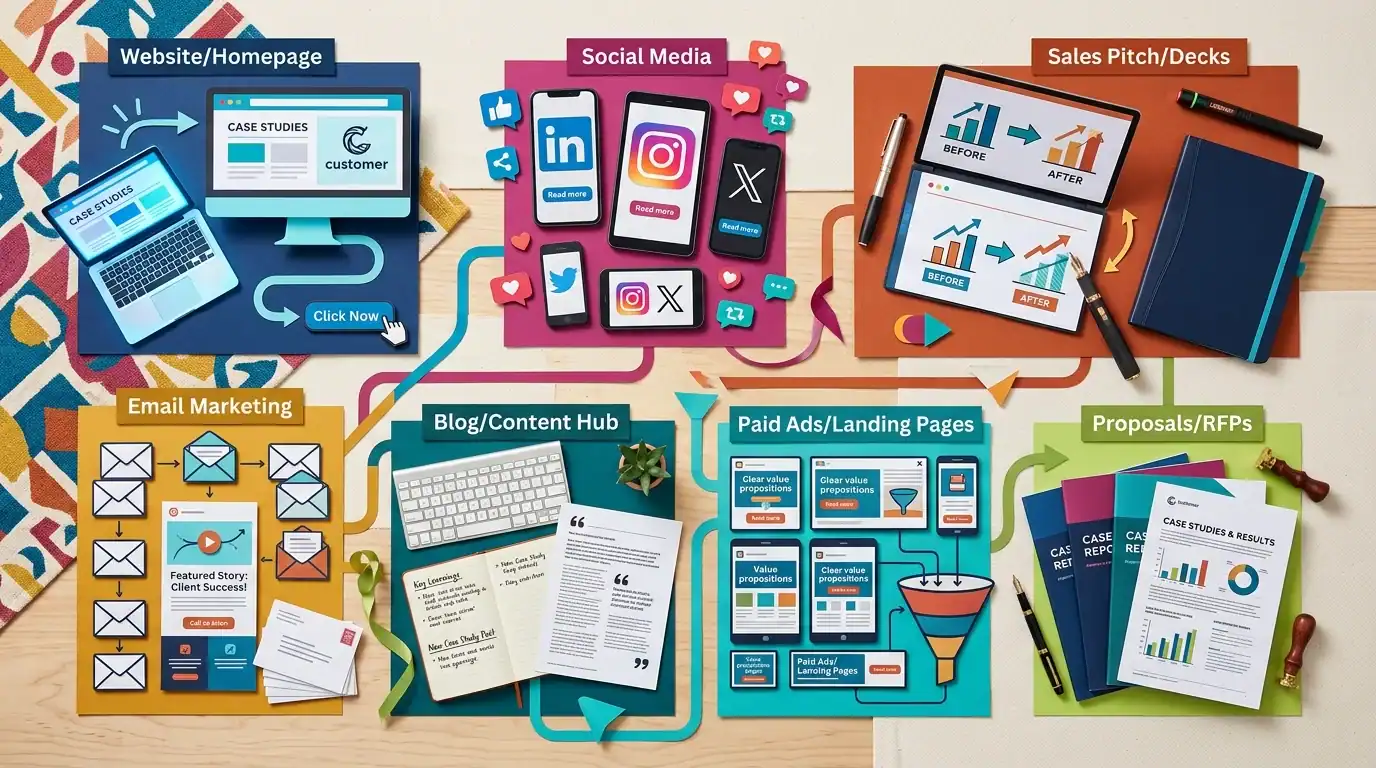
Where to Use Your Case Studies (7 Places)
1. Dedicated Case Study Page on Your Website
Create a page (or section) on your site that houses all your case studies. Link to it from your main navigation or services pages. Organize by industry or service type so visitors can find the most relevant one quickly.
2. Service Pages
Embed relevant case study excerpts (the headline, key result, and a link to the full study) on each service page. If your SEO service page shows a case study about an SEO client who tripled their traffic, it reinforces the sales message exactly when the visitor is evaluating that service.
3. Sales Proposals
Include 2-3 relevant case studies in every proposal. Match the case studies to the prospect’s industry and needs. “Here’s what we did for a similar company in your industry” is the strongest proposal element you can include.
4. Email Nurture Sequences
Case studies make excellent email content for leads who aren’t ready to buy yet. “How we helped a local contractor triple their leads” as an email subject line gets opened because it promises a story with a result. Include case studies as the third or fourth email in your nurture sequence (after the welcome and value emails). This is the “proof” stage of your email funnel.
5. Social Media Content
Turn case study results into social media posts. “We helped [client type] increase their monthly leads from 5 to 25 in 6 months. Here’s how…” This format drives engagement because people want to know the “how.” You can create 5-10 social posts from a single case study — one for each key metric, one for the challenge, one for the solution approach.
6. Google Ads Landing Pages
Case study elements (results numbers, client quotes) serve as social proof on PPC landing pages. A conversion-focused landing page with “250% traffic increase for an Orlando contractor” near the CTA button converts better than one without proof.
7. Sales Conversations
Train your sales team (or yourself) to reference case studies in every sales conversation. “Let me tell you about a client similar to you…” is one of the most effective phrases in selling because it shifts from promises to proof. The prospect stops evaluating your pitch and starts evaluating real results.
How Many Case Studies Do You Need?
Start with 3 — ideally from three different industries or service types. This covers the majority of sales situations. If your top three client types are contractors, professional services, and restaurants, create one case study for each.
Then add 1-2 per quarter as you get new results. Within a year, you’ll have 7-11 case studies covering most scenarios. Having a case study for every common client type means you always have relevant proof when a prospect asks “has this worked for businesses like mine?”
What If Your Results Aren’t Dramatic?
Not every case study needs a 500% improvement or a $1 million revenue increase. Consistent, reliable results are valuable too:
- “We maintained their #1 Google ranking for 3 years while competitors fluctuated” — a case study about consistency and reliability
- “We reduced their cost per lead by 35% while maintaining the same volume” — a case study about efficiency
- “We launched their new website and generated their first 20 online leads within 60 days” — a case study about getting started from zero
- “We increased their Google reviews from 8 to 75 in 6 months” — a case study about reputation building
The key is specificity and relevance, not necessarily dramatic numbers. A prospect who needs consistency cares more about a stability case study than a hockey-stick growth case study.
Case Study Length and Format
- Website page: 500-1,000 words. Scannable with headers, bullet points, and bold key metrics. Include at least one client photo or screenshot
- Social media: 3-5 key bullets or a single compelling metric with context. “From 5 leads/month to 25 — here’s what we changed.”
- PDF download: 1,500-2,500 words. More detailed methodology, additional data, multiple results metrics. Good as a lead magnet or proposal attachment
- Video case study: 2-3 minutes. Client on camera telling their story with before/after visuals. The most persuasive format but requires client cooperation
Frequently Asked Questions

How do I ask a client for a case study?
Ask right after delivering great results, when they’re excited. Frame it as a partnership: “We’re proud of what we achieved together. Would you be open to us documenting this as a case study? We write everything — you just review and approve.” Most say yes.
What if my client doesn’t want to be named?
Anonymize it. “A residential contractor in Orlando” works. You lose some credibility without a name, but the data and narrative still convert. Anonymized case studies are significantly better than no case studies.
How long should a case study be?
500-1,000 words for your website. Shorter for social media (key highlights). Longer for downloadable PDFs (1,500+ words with methodology details). Match the length to the channel.
What metrics should I include?
Whatever matters to your client’s industry. For service businesses: leads, calls, revenue, cost per lead. For e-commerce: traffic, conversion rate, revenue, average order value. For B2B: leads, pipeline value, close rate, customer acquisition cost. Always include at least one revenue or ROI metric — that’s what decision-makers care about most.
Can I create a case study if I don’t have exact numbers?
Approximate numbers are better than no numbers. “Approximately doubled their leads” or “traffic grew from roughly 500 to over 1,500 monthly visitors.” Be honest about what’s estimated versus exact. Even directional results (“significant increase in calls after the website redesign”) add credibility.
How do I write a case study for a client I worked with years ago?
Reach out and ask. “We’ve been working together for 3 years now, and I’d love to document our journey as a case study. Can we schedule a 15-minute call to review the results?” Most long-term clients are happy to participate because they have the most results to show.
Do case studies help with SEO?
Yes. Case study pages targeting industry-specific keywords (e.g., “SEO case study for plumber” or “web design results for contractor Orlando”) rank for commercial-intent searches. People actively search for proof that services work in their industry.
Your Case Study Action Plan
- This week: Identify your top 3 clients with the best results. Reach out and ask for permission
- This month: Write your first case study following the structure above. Publish it on your website
- This quarter: Create 2 more case studies from different industries. Add them to your proposals and email sequences
- Ongoing: Add 1-2 case studies per quarter. Build a library that covers your most common client types
Next Steps

Want help creating case studies for your business? Our content marketing services include case study research, writing, design, and distribution strategy. We handle everything — you just connect us with happy clients.
Schedule a free consultation or call (321) 300-4837.
Read more: Content Marketing ROI | Blogging for Business | Content Strategy Framework
If this raised more questions than it answered, we’ve got answers in our FAQ — covering everything from pricing and timelines to what results actually look like. You can also read verified client reviews from businesses we’ve helped across Orlando and Central Florida.