

Brand Identity Guide: How Small Businesses Build Recognition That Lasts
Your brand identity is more than a logo. It’s how people recognize you, remember you, and feel about your business before they ever pick up the phone. After 30 years in design, advertising, and marketing, I can tell you this with certainty: the businesses that invest in a real brand identity grow faster, charge higher prices, and keep customers longer than those winging it with a Canva logo and random colors.
Brand identity is the difference between a business that looks professional on day one and a business that looks like it was thrown together over a weekend. When your website, your business card, your social media, your truck wrap, and your email signature all look like they belong to the same company, people trust you more. That trust is worth money.
From the auditor: Dennis Ocasio has delivered digital marketing for 200+ small businesses across Central Florida over 30+ years. Every recommendation here comes from tested, real-world client work — not theory.
What Brand Identity Actually Is
Brand identity is the complete visual and verbal system that represents your business everywhere it appears. It includes your logo, your color palette, your typography, your brand voice, your imagery style, and the rules that govern how all of those elements work together consistently.
Think of it this way: your logo is your face. Your brand identity is your entire personality — how you dress, how you talk, how you carry yourself, how you make people feel when they interact with you. People form opinions about your business in the first 3 seconds of encountering it. Your brand identity determines what that opinion is.
A strong brand identity answers these questions instantly: What does this business do? Is this business professional? Can I trust this business? Is this business right for someone like me?
The 5 Core Elements of Brand Identity
1. Logo
Your logo is the anchor of your visual identity. It needs to work at every size (from a billboard to a favicon), in color and black-and-white, on screens and in print. A good logo is simple, memorable, and communicates something about what you do without being too literal.
The biggest logo mistake I see: businesses using a design from Fiverr or Canva that looks like 10,000 other businesses. Your logo should differentiate you, not blend you into the crowd. Check our logo design services for a deeper look at what goes into a professional logo.
2. Color Palette
Colors trigger emotions and associations. Blue communicates trust and professionalism (that’s why banks and tech companies use it). Red creates urgency and energy. Green signals growth, health, and nature. Orange feels friendly and affordable. Black projects luxury and sophistication.
Your palette should include 3-4 colors that work together harmoniously and reflect your brand personality. Every piece of content you create — your website, social media posts, business cards, presentations, signage — should use these colors consistently. No random colors. No “close enough.” The exact same hex codes every time.
You also need the technical specifications for each color: Hex code (for web), RGB values (for digital), CMYK values (for print), and Pantone numbers (for professional printing). Without these specifications, every printer and designer who touches your brand will use slightly different colors.
3. Typography
Your fonts communicate as much about your brand as your colors do. Serif fonts (like Times New Roman or Georgia) feel traditional, established, and trustworthy — law firms, financial advisors, and universities often use them. Sans-serif fonts (like Helvetica, Open Sans, or Montserrat) feel modern, clean, and approachable — tech companies, startups, and contemporary brands lean this way.
Pick 2-3 fonts: one for headings (bold, attention-grabbing), one for body text (clean, readable), and optionally one for accents or special elements. Use them everywhere consistently. Don’t use 7 different fonts across your website and marketing materials — that’s visual chaos.
Google Fonts offers hundreds of professional typefaces for free, so budget isn’t an excuse for poor typography.
4. Brand Voice
How does your business sound when it speaks? Professional and formal? Casual and friendly? Technical and authoritative? Warm and empathetic? Your brand voice should match your audience’s expectations and your business personality.
A law firm sounds different from a surf shop. A pediatric dentist sounds different from a tax accountant. Define your voice — and more importantly, document it so everyone who writes for your business (staff, freelancers, agencies) sounds the same.
Your voice should be consistent across every touchpoint: your website, your social media posts, your email newsletters, your proposals, your customer service responses. One voice. One personality. Everywhere.
5. Imagery Style
The types of photos, illustrations, icons, and graphics you use. Are they bright and colorful or dark and moody? Lifestyle photos of real people or clean product shots on white backgrounds? Hand-drawn illustrations or geometric patterns? Minimalist or detailed?
Pick a style and stick with it. When someone scrolls past your Instagram post or sees your ad, they should recognize it as yours before they even read the text — because the imagery style is consistent with everything else they’ve seen from your brand.
Why Consistency Matters More Than You Think
Consistent branding across all platforms increases revenue by up to 23%. That’s not my estimate — that’s data from multiple marketing studies. The reason is simple: consistency builds recognition, and recognition builds trust.
When your website, your business card, your social media, your truck wrap, and your email signature all look like they belong to the same company, people see you as organized, professional, and reliable. If your website uses one color scheme, your business card uses another, and your Facebook page uses a third — people (consciously or not) think: “This business can’t even keep its own brand straight. Can they handle my project?”
Brand consistency isn’t just an aesthetic preference. It’s a trust signal that directly affects whether people choose to do business with you.
How to Create a Brand Guidelines Document
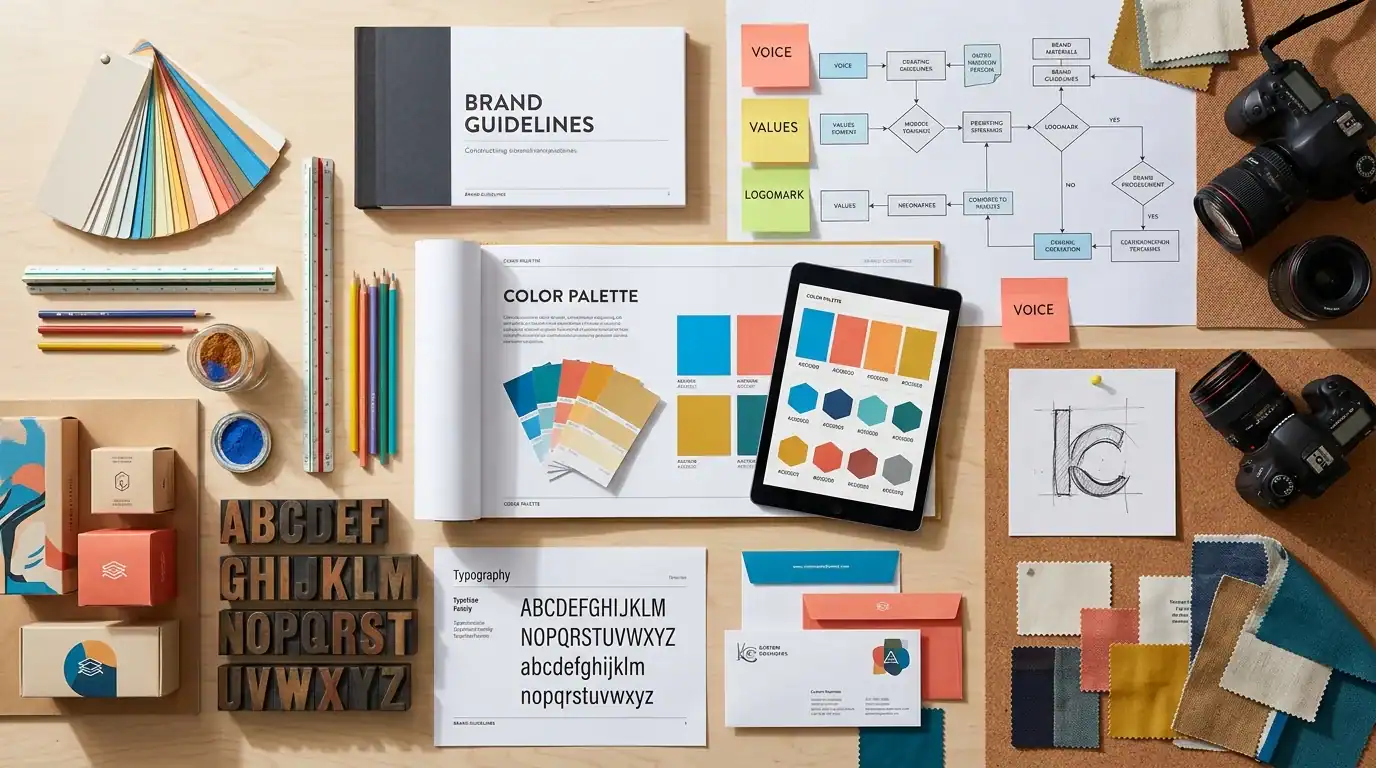
A brand guidelines document (sometimes called a brand book or style guide) is the rulebook for your brand. It tells anyone who creates content for your business — designers, writers, social media managers, print shops, web developers — exactly how to represent your brand correctly.
A comprehensive brand guidelines document includes:
- Logo usage rules: Minimum size, required clear space around the logo, acceptable color variations (full color, black, white, reversed), and examples of incorrect usage (don’t stretch it, don’t change the colors, don’t add effects)
- Color palette: Every brand color with exact codes (Hex, RGB, CMYK, Pantone). Primary colors, secondary colors, and accent colors. When to use each one
- Typography: Font names, sizes, weights, and line spacing for headings, body text, and captions. Where to download or access the fonts
- Brand voice guidelines: Tone description, vocabulary preferences, do’s and don’ts, example phrases. How the voice adjusts for different channels (formal for proposals, casual for social media)
- Imagery guidelines: Photo style, illustration style, icon style. Examples of on-brand and off-brand imagery
- Application examples: How the brand looks on business cards, letterhead, social media posts, email signatures, presentations, and signage
This document saves you thousands of dollars over the life of your business because every contractor, freelancer, and employee you hire knows exactly what to do. No more explaining your brand from scratch every time you work with someone new. Hand them the guidelines and they’re aligned from day one.
Brand Identity on a Budget
You don’t need $50,000 for a brand identity. Here’s what a small business needs at minimum and what it costs:
- Professional logo: $800-$2,000 from a real designer (not Fiverr, not Canva, not your nephew who “knows Photoshop”). This is the one thing you should never cheap out on
- Color palette: 3-4 colors chosen with intention, not randomly. Your logo designer can help define these during the logo process (often included)
- Typography: 2-3 fonts from Google Fonts (free) chosen to complement your logo and brand personality
- Brand voice notes: A one-page document describing how your brand sounds. You can write this yourself based on your natural communication style
- Business card design: $200-$500 for professional design + printing
- Basic guidelines document: 4-8 pages covering logo, colors, fonts, and voice. $500-$1,000 if your designer creates it; free if you document it yourself using the elements above
Total minimum investment: $1,500-$4,000. That’s not expensive. That’s the cost of looking professional, building trust from the first interaction, and saving countless hours of “what color should this be?” conversations over the next 5-10 years.
For a comprehensive brand identity package with full guidelines, social media templates, letterhead, and email signature designs: $3,000-$10,000 depending on scope.
Common Branding Mistakes Small Businesses Make
- Using too many colors: Stick to 3-4. More than that looks chaotic and unprofessional. Every color in your palette should have a purpose
- Different logos on different platforms: Your website shows one version of your logo, Facebook shows another, and your business card has a third. Use the exact same logo everywhere. Same colors. Same proportions. No exceptions
- No brand guidelines: Without documented rules, every person who touches your brand interprets it differently. Your designer makes one version, your social media manager makes another, and your print shop improvises a third. Guidelines fix this
- Copying competitors: Your brand should differentiate you, not blend you into the crowd. If every competitor uses blue, maybe you should use orange. Stand out
- Changing your brand every year: Brand recognition takes time to build. If you redesign your logo, change your colors, or alter your voice every 12 months, you’re starting from zero each time. Commit to your brand for at least 3-5 years. Evolution is fine. Revolution is wasteful
- Skipping the guidelines: “We’ll just remember what our brand looks like” — no, you won’t. And the freelancer you hire next month definitely won’t. Document everything
How Brand Identity Connects to Your Marketing
A strong brand identity makes every other marketing activity more effective:
Your website converts better because it looks professional and consistent. Visitors trust a polished site more than one that looks thrown together.
Your social media builds recognition because every post looks like it comes from the same company. Followers start recognizing your content in their feed before they read a single word.
Your Google Ads perform better because a consistent, professional brand makes your ads more memorable and clickable. Ad creative that matches your website’s look creates a seamless experience that converts.
Your SEO content builds authority because a professional brand signals to both readers and search engines that your business is legitimate and trustworthy.
Your brand identity is the thread that ties all your marketing together. Get it right once, and everything else gets easier and more effective.
When to Consider a Rebrand

Sometimes the right move is to update your existing brand identity. Consider a rebrand when:
- Your business model has fundamentally changed (you started as a freelancer and now you’re an agency)
- Your current brand looks dated (designs from 2005 don’t work in 2026)
- You’re targeting a different audience than when you started
- Your current logo and brand materials don’t work digitally (no vector files, can’t scale, doesn’t work on dark backgrounds)
- You’ve outgrown your original brand and it no longer represents who you are
Don’t rebrand just because you’re bored with your current look. Rebranding costs money, confuses existing customers, and resets the brand recognition you’ve built. Only rebrand when there’s a genuine business reason.
Frequently Asked Questions
How long does it take to build a brand identity?
A basic brand identity (logo + colors + fonts + simple guidelines) takes 3-6 weeks from start to finish. A comprehensive brand identity with full guidelines, stationery suite, social media templates, and brand book takes 6-12 weeks. The discovery and strategy phase at the beginning is what makes or breaks the outcome — don’t rush it.
Do I really need brand guidelines?
If you ever plan to have anyone else create content for your business — a designer, a social media manager, a printer, a web developer, a marketing agency — yes, absolutely. Without guidelines, your brand will look different every time someone new touches it. Guidelines are a one-time investment that pays off for years.
Can I create my own brand identity?
You can handle some elements yourself (brand voice, choosing Google Fonts, writing your brand story). But the logo should be designed by a professional. A DIY logo almost always looks like a DIY logo, and that perception follows your business everywhere.
How much should I budget for brand identity?
$1,500-$4,000 for basics (logo, colors, fonts, business card). $3,000-$10,000 for comprehensive (full guidelines, templates, stationery suite). The investment depends on your industry, your competition, and how many applications you need designed.
What’s the difference between brand identity and branding?
Brand identity is the tangible system — logo, colors, fonts, voice, guidelines. Branding is the ongoing process of building perception and recognition in your market over time. Brand identity is what you create. Branding is what people experience and remember.
How do I know if my current brand identity needs updating?
Ask yourself: Does my brand look professional compared to my competitors? Does my website, business card, and social media all look like the same company? Can I scale my logo to any size without quality loss? Do I have brand guidelines I can hand to a new designer? If the answer to any of these is no, it’s time for an update.
Ready to Build a Brand Identity That Lasts?

We offer full logo design and branding services plus graphic design for everything your brand needs. With 30 years of design experience, I bring a perspective most designers can’t — I understand not just how to make your brand look good, but how to make it work as a business tool that drives trust and revenue.
Let’s talk about your brand or call (321) 300-4837.
If this raised more questions than it answered, we’ve got answers to common Logo Design questions in our FAQ — covering everything from pricing and timelines to what results actually look like. You can also read verified client reviews from businesses we’ve helped across Orlando and Central Florida.
If you want to see a modern shortcut to the whole process, my guide on how to build a design system with AI using Claude Design shows what is possible in a single afternoon.
Once your brand identity is locked in, the next step is building the website to match — here is what website design costs in Orlando look like in 2026.

