

Content Strategy Framework: How to Plan and Execute Marketing Content Like a Pro
Most businesses create content randomly. They write a blog post when they feel inspired, share something on social media when they remember, and send an email newsletter when someone reminds them. There’s no plan. No purpose. No measurement. And then they wonder why their content strategy isn’t driving results.
After 30 years in marketing and helping hundreds of small businesses in Orlando build their content programs, I can tell you the difference between businesses that grow from content and businesses that waste time on it: a framework. Not a complicated 50-page strategy document. A practical, repeatable framework that tells you what to create, when to create it, where to publish it, and how to measure if it’s working.
Let me walk you through the exact content strategy framework I use with my clients at Ocasio Consulting.
From the auditor: Dennis Ocasio has delivered digital marketing for 200+ small businesses across Central Florida over 30+ years. Every recommendation here comes from tested, real-world client work — not theory.
Why Most Content Strategies Fail
Before I show you the framework, let’s talk about why most content efforts fail. Understanding these failure points will help you avoid them.
No keyword research. You’re writing about topics nobody is searching for. Your blog post about “our company picnic” might be fun to write, but zero potential customers are googling it. Without keyword research, you’re creating content in the dark.
No consistency. You publish 4 posts one month, then nothing for 3 months, then 2 posts, then silence again. Google notices this inconsistency. Your audience notices it too. Consistency beats quality in the early stages — a decent post every week beats a perfect post every quarter.
No funnel alignment. All your content targets the same stage of the buyer journey. If everything you write is “top of funnel” educational content (“What is SEO?”), you’re attracting people who aren’t ready to buy. You need content at every stage: awareness, consideration, and decision.
No measurement. You publish content but never check if it’s working. You don’t know which posts drive traffic, which generate leads, or which are invisible to everyone. Without measurement, you can’t improve.
No repurposing. You spend 4 hours writing a blog post, publish it once, and never touch it again. That’s a waste. One good blog post can become 10 social media posts, an email newsletter, a LinkedIn article, a podcast topic, and a sales talking point.
The 6-Step Content Strategy Framework

Step 1: Define Your Audience and Their Problems
Start with your customer, not your product. Who are you trying to reach? What problems keep them up at night? What questions do they ask before they hire someone like you?
Write down your top 3 customer types (personas). For each one, list:
- Their job title or role (business owner, marketing manager, homeowner)
- Their biggest pain points (not getting enough leads, website doesn’t convert, can’t figure out social media)
- The questions they type into Google (how much does web design cost, what is local SEO, should I hire a marketing agency)
- Where they spend time online (Facebook, LinkedIn, Instagram, Google, industry forums)
- What stage of buying they’re in (just researching, comparing options, ready to hire)
This exercise takes 30 minutes and shapes your entire content strategy. Every piece of content you create should target one of these personas and answer one of their questions.
Step 2: Keyword Research and Topic Mapping
Now turn those customer questions into keyword-targeted content topics. Use tools like Google Search Console (free), Ubersuggest (free tier), or Ahrefs/SEMrush (paid) to find:
- Search volume: How many people search for this term monthly?
- Competition: How hard is it to rank for this term?
- Intent: Is the searcher looking for information, comparing options, or ready to buy?
Map your topics into clusters that align with your services. If you offer SEO services, your SEO cluster might include: “how long does SEO take,” “local SEO pricing,” “SEO vs PPC,” “Google Business Profile optimization,” and “what is on-page SEO.” Each topic becomes a blog post that links back to your SEO service page.
This cluster approach is exactly how we’ve structured the content on this site — and it’s how Google understands that we’re an authority on digital marketing topics.
Step 3: Map Content to the Buyer Journey
Not all content serves the same purpose. You need content at three stages:
Top of Funnel (TOFU) — Awareness: People know they have a problem but don’t know the solution yet. Content: educational blog posts, how-to guides, industry overviews. Example: “What Is Local SEO?” or “How Long Does SEO Take?”
Middle of Funnel (MOFU) — Consideration: People understand the solution and are comparing options. Content: comparison guides, case studies, detailed service explanations. Example: “SEO vs PPC: Which Is Right for Your Business?” or “How to Choose a Digital Marketing Agency”
Bottom of Funnel (BOFU) — Decision: People are ready to buy and choosing who to hire. Content: pricing guides, testimonials, portfolio, free consultations. Example: “Local SEO Pricing Guide” or “Google Ads Cost in Orlando”
Most businesses only create TOFU content. That’s a mistake. BOFU content converts at 3-5x the rate of TOFU content because the searcher is already ready to take action. My recommendation: 40% BOFU, 30% MOFU, 30% TOFU.
Step 4: Create a Content Calendar
A content calendar turns your strategy into an execution plan. It answers: what gets published, when, on which channel, targeting which keyword, for which persona, at which funnel stage.
Here’s the publishing cadence I recommend for small businesses:
- Blog posts: 2-4 per month (minimum 2). Each post targets one primary keyword, links to your service pages, and includes a CTA
- Email newsletter: 2-4 per month. Repurpose your blog content into email-friendly format
- Social media: 3-5 posts per week per platform. Repurpose blog content into social snippets, tips, quotes, and graphics
- LinkedIn (if B2B): 3-5 original posts per week. Different from your blog — more personal, more opinion-driven
Plan 4-12 weeks ahead. Use a simple spreadsheet or a tool like Trello, Asana, or CoSchedule. The goal isn’t perfection — it’s consistency. A planned calendar that you follow beats an ambitious calendar that you abandon.
Step 5: Create and Optimize Content
Every piece of content should follow these rules:
- Primary keyword in the title, H1, first paragraph, and URL slug
- Secondary keywords in H2 subheadings where natural
- 1,800-2,500 words for blog posts targeting competitive keywords (shorter for simple topics)
- Internal links to your service pages and related blog posts (at least 3-5 per post)
- External links to authoritative sources that support your points (1-2 per post)
- Clear CTA at the end of every post (call us, schedule a consultation, read the next article)
- FAQ section with 5-7 questions that match “People Also Ask” results
- Meta title and description optimized for clicks in search results
Write for humans first, optimize for search engines second. If your content doesn’t genuinely help the reader, no amount of SEO trickery will save it. Google is too smart for that in 2026.
Step 6: Measure, Analyze, and Adjust
Track these metrics monthly:
- Organic traffic: Are more people finding you through Google? (Google Analytics)
- Keyword rankings: Are your target keywords moving up? (Google Search Console or Ahrefs)
- Leads from content: How many people contacted you after reading a blog post? (Conversion tracking)
- Time on page: Are people actually reading your content or bouncing immediately?
- Top performing content: Which posts get the most traffic and leads? Create more like them
- Underperforming content: Which posts get zero traffic? Update them, improve them, or redirect them
Review your content performance quarterly. Double down on what works. Fix or remove what doesn’t. Update old content with fresh information. This iterative process is how content marketing compounds over time. Read our content marketing ROI guide for detailed measurement advice.
Repurposing: Get 10x Value From Every Piece of Content
One blog post can become:
- 5-10 social media posts (pull key quotes, stats, tips)
- An email newsletter issue
- A LinkedIn article or carousel
- An infographic
- A video script (read the highlights on camera)
- A podcast episode topic
- A sales deck talking point
- A client FAQ answer
If you’re spending 4 hours writing one blog post and only publishing it once, you’re getting 10% of its value. Repurpose systematically and every piece of content works 10x harder.
Common Content Strategy Mistakes
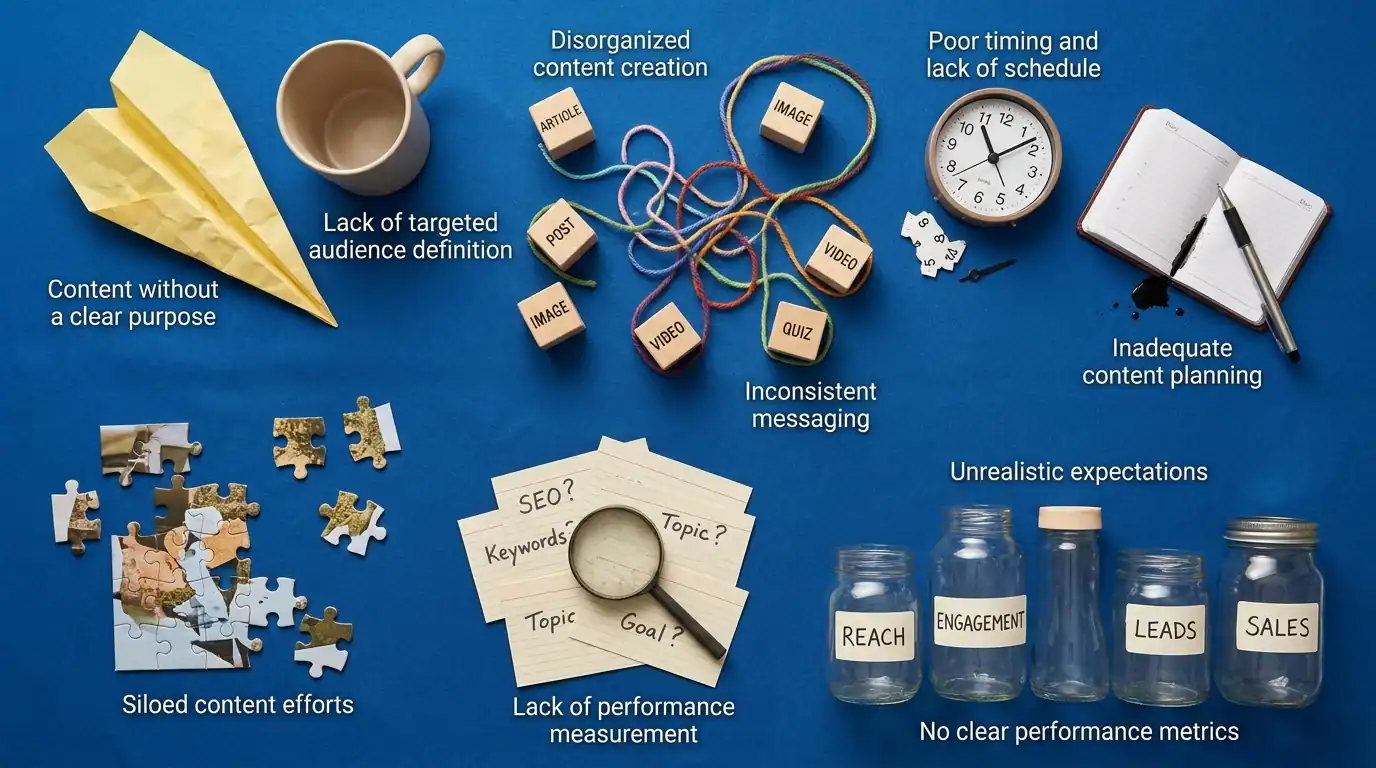
- Writing for yourself instead of your customer: Your audience doesn’t care about your company news. They care about solving their problems
- No keyword targeting: Every post should target a specific keyword people actually search for
- Inconsistent publishing: Google and your audience both reward consistency. Commit to a schedule and stick to it
- All TOFU, no BOFU: If every post is educational, you attract researchers, not buyers. Mix in commercial and transactional content
- No internal linking: Every new post should link to related posts and service pages. This helps SEO and keeps visitors on your site longer
- Not updating old content: Posts from 2 years ago with outdated information hurt your credibility. Update them regularly
Frequently Asked Questions
How long does it take for a content strategy to show results?
3-6 months for measurable traffic growth. 6-12 months for consistent lead generation. Content marketing is a long game — but the businesses that commit to it for 12+ months almost always see significant ROI. Read our SEO timeline guide for month-by-month expectations.
How many blog posts do I need per month?
Minimum 2 per month. 4 is better. More than 4 is great if you can maintain quality. Consistency matters more than volume — 2 excellent posts per month beats 8 mediocre ones.
Should I hire a writer or do it myself?
If you can commit 4-8 hours per month to writing and have genuine expertise to share, writing yourself adds authentic E-E-A-T signals. If you can’t commit the time or struggle with writing, hire a professional who can capture your voice and expertise. Our content marketing services handle this for businesses that’d rather focus on running their company.
What’s the most important content to create first?
BOFU content. Start with pricing pages, comparison guides, and service-specific articles. These target people ready to buy and convert at the highest rates. Then build out MOFU and TOFU content to fill the pipeline.
How do I come up with content ideas?
Ask your sales team what questions customers ask most. Check Google’s “People Also Ask” for your target keywords. Look at what competitors are writing about. Review your Google Search Console for queries your site is already showing up for. Use AnswerThePublic.com for question-based keyword ideas.
Your Content Strategy Action Plan

- Week 1: Define 3 customer personas and their top 10 questions
- Week 2: Research keywords for those questions. Map topics into clusters
- Week 3: Build a 12-week content calendar (2-4 posts per month)
- Week 4: Write and publish your first 2 blog posts
- Monthly: Publish on schedule. Repurpose into social and email. Track results
- Quarterly: Review performance. Update strategy. Adjust based on data
Next Steps
Need help building your content strategy? We’ve designed and executed content programs for businesses across Central Florida. Our content marketing services include strategy, keyword research, writing, optimization, and performance tracking.
Schedule a free consultation or call (321) 300-4837.
Read more: Blogging for Business | Content Marketing ROI | What Is Content Marketing
If this raised more questions than it answered, we’ve got answers to common Content Marketing questions in our FAQ — covering everything from pricing and timelines to what results actually look like. You can also read verified client reviews from businesses we’ve helped across Orlando and Central Florida.